Running Theme Ops Across 25 Client Stores
One store is a project. Twenty-five is an operation — and the things that break are almost never the code.
What actually changes with scale
The work per store doesn't get harder. What changes is that context stops being free.
On one store you know what's live, what's in flight and what the client is waiting on, because it's the only thing you're doing. At twenty-five, none of that is in anyone's head. It has to be somewhere you can look, or it doesn't exist.
The failures that follow are consistent across agencies:
- Credential sprawl. Theme Access passwords in a spreadsheet, a password manager, three
.envfiles and a Slack thread from 2024. - Silent sync failures. A store's tracking broke six weeks ago. Nobody noticed because nobody was looking at that store.
- Lost review rounds. A client was sent a preview in August and never replied. Nobody chased, because nobody owned the list.
- Unverifiable offboarding. A developer left in June. Which client stores can they still write to? Nobody can answer.
- Inconsistent process. Each store was set up by whoever was free, so each one works slightly differently.
Credentials: the thing to fix first
Every Theme Access password can overwrite a live storefront. Treat them like production deploy keys, because that's what they are.
Three properties that matter
- One credential per store. Never reuse across clients. A leak stays contained.
- Held centrally and encrypted. Not on laptops, not in chat, not in a shared sheet. Central storage is what makes an audit possible at all.
- Revocation is a checklist item. At project close, revoke and tell the client you did. Clients remember this — it's a differentiator worth almost nothing to deliver.
| Where credentials live | Can you audit access? | Can you offboard cleanly? |
|---|---|---|
| Developer laptops, local config | No | No |
| Shared spreadsheet | Sort of — who copied it? | No |
| Chat messages | No | No |
| Team password manager | Partially | Partially |
| Central, encrypted, per store | Yes | Yes |
Naming conventions do more work than they should
Unglamorous and disproportionately effective. At scale, a name is often the only context available to whoever finds a thing.
# Themes on a client store
LIVE — Dawn 15.2
STAGING — checkout revamp — 2026-10
BACKUP — pre-BFCM — 2025-11-14 — delete after 2026-02
AGENCY — homepage refresh — delete on launch

# Branches
production                      # mirrors the live theme
feature/plp-filters
release/2026-10-12
Three questions a good name answers: what is this, when was it made, and when can it go. The third is the one everyone omits and the one that makes cleanup possible by someone who wasn't there.
Apply the same discipline to how work is labelled. If a theme is called "homepage refresh" everywhere — branch, theme, review link, invoice line — then anyone can follow the thread without asking.
Sync health has to be a dashboard, not a memory
Tracking a live theme into git is only valuable while it's working. A sync that silently stopped is worse than no sync, because you'll trust a record that stopped being true.
Four states worth distinguishing:
| State | Means | Action |
|---|---|---|
| Healthy | Pulled recently, no errors | Nothing |
| Syncing | Running now | Nothing |
| Stale | Hasn't pulled in longer than expected | Check credentials and interval |
| Error | Last attempt failed | Fix before any deploy to that store |
The requirement is seeing this across all stores at once. Checking twenty-five stores individually is a task nobody does, which means the information may as well not exist.
Roles, so access doesn’t depend on who’s free
Small teams share one login and it works fine until it doesn't. Roles matter for two practical reasons, neither of which is bureaucratic.
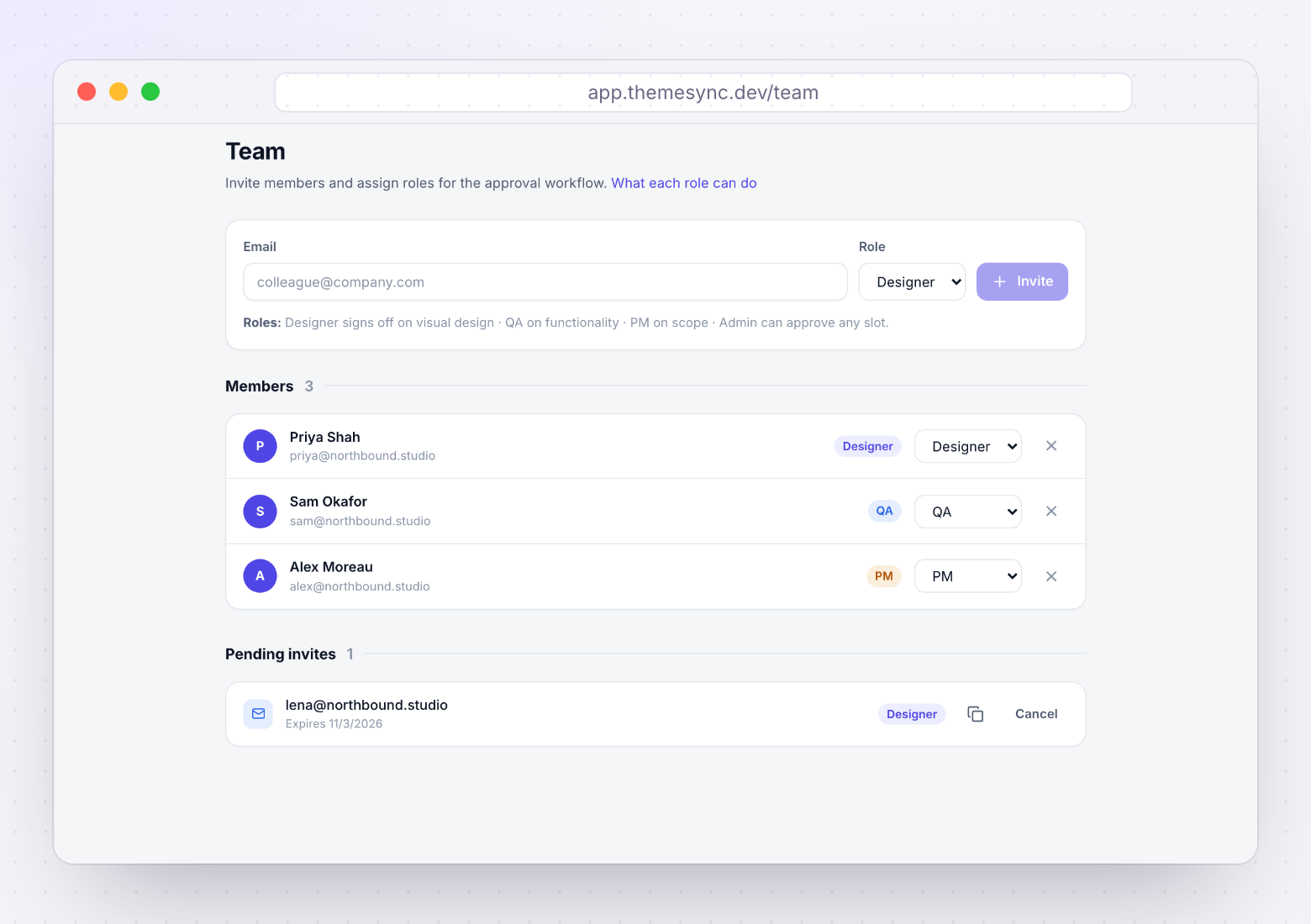
Onboarding and offboarding become events, not projects. A designer joins and gets designer access to the stores they're on. They leave and it's removed. Without roles, both operations are archaeology.
Sign-off means something. If everyone has the same access, "approved by QA" is just a person's name. If QA is a role, an approval carries information about who was competent to give it.
- Credentialsauditable
One per store, central, encrypted, revoked at close.
- Namingself-documenting
What it is, when it was made, when it can be deleted.
- Sync healthone view
Healthy, syncing, stale or error — across every store on one screen.
- Rolesclean offboarding
Design, QA and PM access defined once, not per person per store.
Client communication at portfolio scale
The operational failure clients actually notice isn't a broken sync. It's silence.
A preview goes out, the client doesn't reply, and it drops off everyone's radar because no one owns the list of outstanding reviews. Three weeks later the client asks why their project hasn't moved — having been the blocker — and it still reads as your fault, because you didn't chase.
Two things fix most of this:
- A single view of what's awaiting a client. Which reviews are open, which pages are unapproved, how long they've been waiting. That's your chase list and it should take one glance.
- Stable review links per store. If every round needs a fresh link, every round has a moment where the client can't find the current one — and that's where projects stall.
How ThemeSync supports a portfolio
- Credentials are stored per store, encrypted at rest. Access is centralised rather than distributed across laptops and chat threads, so an audit is possible and offboarding is verifiable.
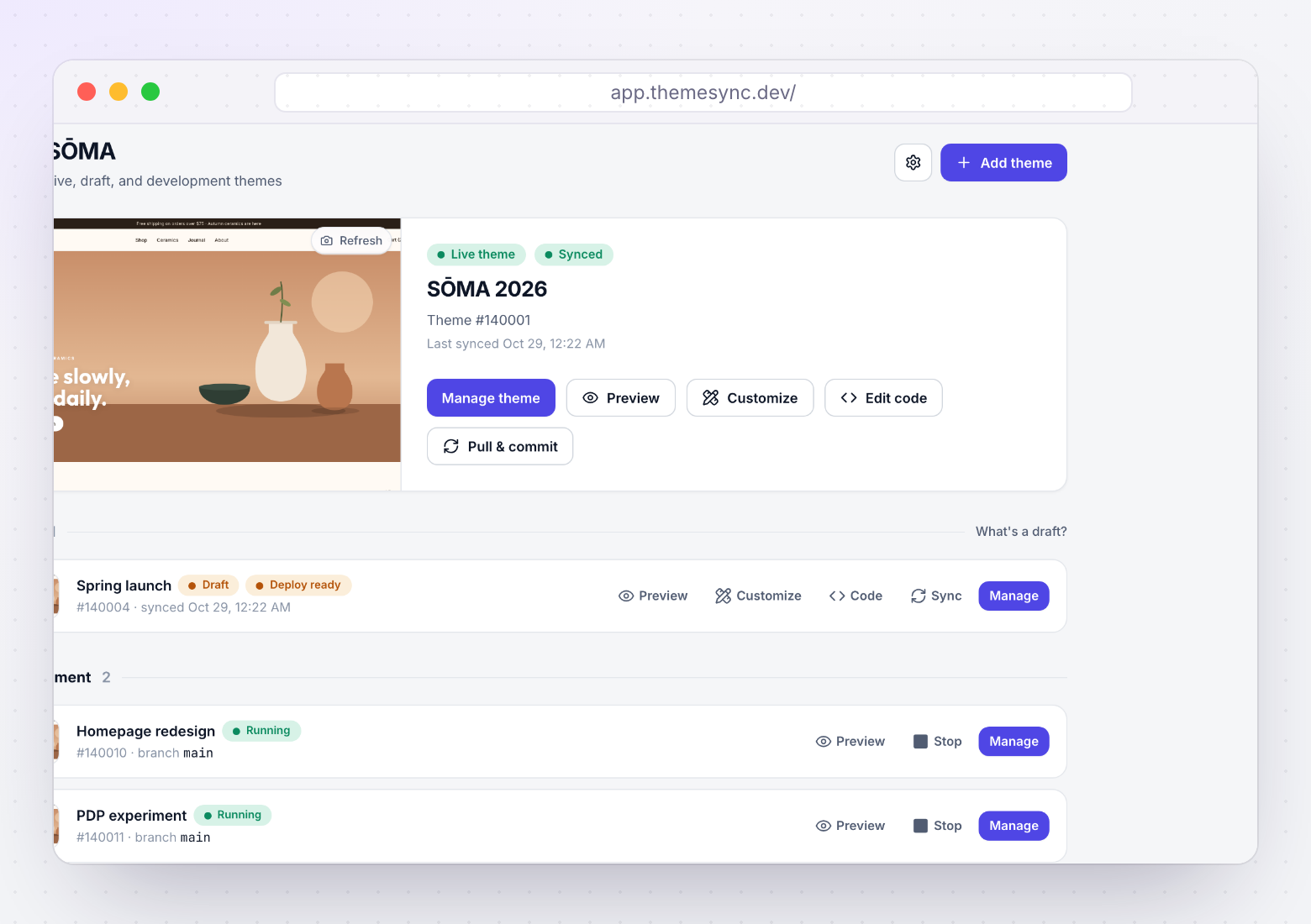
- Stores are first-class. A store switcher plus a per-store home means "what's happening on this client" is a place you go, not a thing you reconstruct.
- Sync state is visible per store. Healthy, syncing, stale or error, so a broken tracker surfaces before it becomes a bad deploy.
- Untracked live themes are flagged. Stores whose live theme nobody is watching get surfaced rather than quietly forgotten.
- Team members have roles. Designer, QA and PM access is defined once, and approvals record which role signed off.
- Feedback is summarised per theme. Open comments and outstanding approvals are visible, so the chase list is a view rather than a memory.
- Review links are stable per theme. The client keeps one URL across revision rounds.
Takeaways
- Scale doesn't make the work harder — it makes context expensive. What isn't visible somewhere stops existing.
- Fix credentials first: one per store, central and encrypted, revoked at project close.
- If you can't list what a departed developer can still write to, that's the most urgent gap you have.
- Naming conventions are cheap and do a disproportionate amount of work. Always include when a thing can be deleted.
- Sync health must be visible across all stores at once, and an error state should block deploys.
- Roles make onboarding and offboarding events rather than investigations, and make sign-off meaningful.
- Own the list of what's awaiting a client. Silence is the failure clients actually notice.
Twenty-five stores, one place to look
ThemeSync keeps per-store credentials encrypted, shows sync health across your portfolio, flags untracked live themes, and gives every theme a stable client review link.
Try ThemeSync Free →